// ENGINEERING IN PRACTICE

Complex systems.
Grounded in real workflows.

Explore how we connect AI, customer conversations, and operational systems—built around the people who rely on them and the decisions the software needs to support.

01 — SELECTED WORK

See the problem behind the system.

Open a case to inspect the customer or operator workflow, system boundaries, guardrails, and what the build made possible.

02 — HOW WE WORK

Ownership, visibility, and production discipline.

Our delivery model keeps product decisions with your team and engineering coordination with the squad. See the operating system behind the work.

Explore the Studio
03 — YOUR PROJECT

Let’s start with the problem.

Bring the feature, bottleneck, or system decision that’s taking up your team’s attention.

Book Discovery Call
INFOSHYLA // CASE FILE 01
D2C BEAUTY / CONVERSATIONAL COMMERCE

From product questions to connected commerce.

An omnichannel conversational AI for a direct-to-consumer hair-oil brand—built to answer with brand and customer context, connect to the ERP and service providers, and take approved actions through its tools.

RAGAGENTIC WORKFLOWSOMNICHANNELERP INTEGRATION
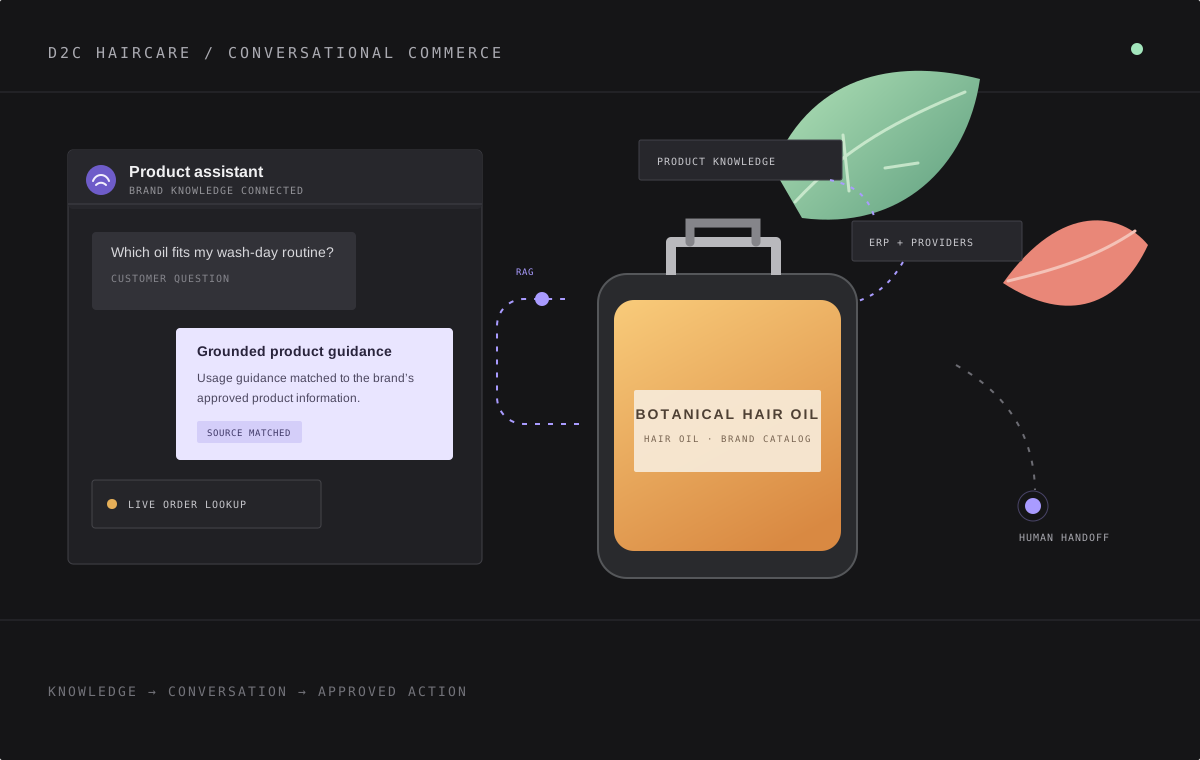
A conversational commerce system connecting customer questions to haircare knowledge and operational systems.

Haircare discovery and order support share one conversation—but not one source of truth.

Before purchase, shoppers need help navigating product fit, ingredients, routine, and usage. After purchase, the questions shift to an individual order or customer request. Both can arrive through different channels, but the information behind them is spread across approved brand material, customer records, service providers, and the ERP.

A FAQ bot leaves the operational question unanswered. A model connected directly to every record and action creates a different risk: it can retrieve too much, confuse old product content with live order state, or attempt an operation outside the request. The system had to identify the task first, fetch only the relevant context, and keep answers distinct from actions.

THE ENGINEERING REQUIREMENT

Give customers a continuous conversational experience while keeping product guidance grounded, customer data scoped, and transactional changes under deterministic system control.

A layered request path—not a single prompt with access to everything.

A / SOURCE PIPELINE

Prepare the brand’s knowledge for retrieval

Product details, ingredient lists, usage guidance, and support policies need to be normalized into retrievable records with product and source metadata. Version and freshness matter: a discontinued item or revised instruction must not remain indistinguishable from current guidance.

B / INTENT ROUTING

Identify what the customer is trying to do

Separate product discovery and usage questions from customer-specific service requests. This determines whether the next step is a knowledge answer, a clarifying question, a live system lookup, or an approved tool action.

C / GROUNDED RETRIEVAL

Retrieve a narrow, relevant context

Search the appropriate product or support material using the intent and current conversation. Use source metadata and relevance thresholds; when reliable support is missing or sources conflict, ask for clarification or decline to make a claim rather than fill gaps with model memory.

D / CUSTOMER CONTEXT

Keep private records out of broad retrieval

Customer-specific context comes from connected systems, not from a shared product-knowledge index. Resolve identity and authorize access outside the language model, then retrieve only the fields needed for that request.

E / PROVIDERS + ERP

Make system state authoritative

Provider and ERP integrations normalize different response formats and authentication boundaries. Current order or account state is read from the system that owns it; retrieved documents do not override transactional records.

F / TOOL ORCHESTRATION

Constrain each action to an explicit contract

Expose only named operations with typed inputs and bounded outputs. Validate arguments and business preconditions in application logic, then use the confirmed provider response—not the model’s intention—to describe whether the action succeeded.

Every boundary creates a failure mode the customer can feel.

01

Stale or contradictory product guidance

Product instructions, ingredients, availability, and service policies can change at different rates. Versioned sources and refresh checks prevent the assistant from treating a superseded answer as current; operational facts are queried live.

02

High-volume customer data and cross-customer leakage

Large histories add noise and inference cost, while a missing identity boundary can expose one shopper’s details to another. The safe path resolves the customer first, enforces authorization in the service layer, and injects only task-relevant fields into the model context.

03

Prompt injection in messages or retrieved content

A customer message or ingested document can contain instructions aimed at overriding the assistant. Treat user and retrieved text as untrusted data, keep policy instructions separate, and never let retrieved content grant new access or tools.

04

Provider timeout, duplicate action, or partial completion

Retries can accidentally repeat a side effect; a timeout can occur after a provider has already processed a request. Bound retries, use idempotency for repeatable writes where supported, record correlation IDs, and verify final state before reporting success.

05

Beauty advice crossing into medical claims

Ingredient and routine guidance must stay within substantiated brand material. The assistant should not diagnose scalp conditions, guarantee hair-growth outcomes, or invent contraindications; unsupported health-related requests need a safe, non-diagnostic response and an appropriate support path.

The model can propose a next step. The application decides what is permitted.

DATA BOUNDARY

Identity verification and authorization happen in the service layer. Scope customer and order lookups to the authenticated customer; do not let the model select arbitrary customer records or expand its own permissions.

ACTION BOUNDARY

Use an allow-list of task-specific tools, strict input schemas, and server-side business-rule checks. Require customer confirmation for consequential or irreversible actions; never treat natural-language intent as authorization by itself.

ANSWER BOUNDARY

Ground product claims in approved, current source material. Set a minimum evidence threshold, retain source provenance for review, and ask, abstain, or route to the support process when evidence is missing or conflicting.

OUTPUT BOUNDARY

Validate model output before rendering it or passing fields to a provider. Keep secrets out of prompts and logs, redact unnecessary personal data, and retain an auditable record of the tool request, authorization decision, provider result, and response status.

FAILURE BOUNDARY

Apply timeouts, bounded retries, rate limits, and provider-specific failure handling. If the system cannot verify a result, say the action could not be confirmed; do not present a guessed or partially completed transaction as successful.

EVALUATION BOUNDARY

Test the full conversation and tool path—not only answer fluency—including prompt injection, wrong-customer access, unsupported product claims, stale records, malformed arguments, duplicate calls, and provider outages.

Treat retrieved content as evidence, customer identity as an authorization boundary, and every tool call as a controlled transaction—not as a privilege granted to the model.

Spend reasoning and context only where they improve the outcome.

Large prompts are not a substitute for relevant context. Keep customer history out of the default request; retrieve product records by intent; pass a compact, structured tool result back to the conversation. Stable, public product content can use a cache with a refresh policy, while personal or transactional responses must not be reused across customers.

Route simple, well-defined intents through a lighter path and reserve deeper reasoning for ambiguous or multi-step requests. Keep deterministic lookups and business rules outside the model. This reduces unnecessary input tokens and avoids paying for complex generation when a direct retrieval or provider call is enough.

Track p95 response latency, input/output tokens per resolved conversation, retrieval relevance, grounded-answer rate, tool success and failure, and cost per completed task. Optimize the inference layer against these together: lower token cost is not a win if it increases wrong answers, failed actions, or support rework.

A conversational layer that can answer with context and move work forward.

Consistent channel experienceMultiple customer-facing providers connect to a common conversation and orchestration layer.
Product answers with provenanceRAG grounds product and usage guidance in the brand’s knowledge rather than generic model memory.
Customer-specific service pathsERP and provider integrations supply live business context and expose approved actions to the assistant.
Operational controlData access, action permissions, failure behavior, and evaluation can be handled as explicit system boundaries.

The architecture moves beyond an information-only bot: it connects customer intent to current business state and controlled operations, while the ERP and integrated providers remain authoritative. The brand gets a path from discovery and support questions through to an action in the systems running its business.

INFOSHYLA // CASE FILE 02
BEAUTY E-COMMERCE / CONVERSATIONAL SALES

A sales conversation that reaches a verified order.

A commerce assistant for a beauty brand selling across multiple online platforms. It understands buying intent, nurtures the conversation, prepares order and payment steps, answers tracking questions, and brings a person in when the conversation needs judgment.

INTENT ROUTINGDRAFT ORDERSPAYMENT LINKSHUMAN HANDOVER
Beauty commerce assistant moving from product discovery to an order that awaits verified payment.

A chat that answers questions but cannot complete the buying journey leaks intent.

A shopper may need help comparing a product, selecting the correct variant, checking availability, or deciding whether to buy. On a multi-platform storefront, price, catalog, order, and tracking context can differ by channel. A generic answer bot cannot reliably carry a qualified shopper into a valid order, and a sales representative who joins late may have to repeat the discovery conversation.

The requirement was a conversational sales flow that could recognize what the shopper wanted, continue nurturing without losing context, use the correct commerce system for the next action, and hand the conversation to a human when automation was no longer the right path.

THE TRANSACTIONAL RULE

Creating an order draft or payment link is not proof that payment occurred. The commerce system and verified payment result remain authoritative.

Move through explicit states instead of treating every message as a fresh prompt.

A / INTENT + PRODUCT DISCOVERY

Classify the shopper’s next decision

Distinguish product questions, comparison, variant selection, buying intent, order status, and requests for a person. Ask a clarifying question when product or variant selection is ambiguous rather than silently choosing one.

B / LEAD CONTEXT

Nurture from what the shopper has already said

Carry the conversation’s useful context into the next step and CRM record. Preserve the source platform and consent/status context so follow-up can be relevant rather than a disconnected or repeated sales message.

C / PLATFORM CONNECTORS

Normalize commerce differences

Map each connected storefront’s product identifiers, variant state, order identifiers, and status values into a common conversation flow. Read price, stock, and order state from the relevant commerce source instead of relying on cached model context.

D / ORDER PREPARATION

Create a draft the customer can review

Build an order draft from the selected catalog item and confirmed customer details. Present the material details—product or variant, quantity, price, and destination where applicable—before the customer moves to payment.

E / PAYMENT + CRM

Separate link creation from settlement

Create the payment link through the connected payment flow. Update CRM order status only after a trusted payment result is verified and mapped to the correct draft, customer, and platform order.

F / HUMAN HANDOVER

Transfer context, not just the chat

When the shopper requests a person, intent is unclear, or an exception needs judgment, pass the conversation summary, intent, products discussed, and current order/payment state to the human queue. Avoid parallel bot replies after transfer.

Keep the assistant helpful while keeping the transaction deterministic.

PAYMENT AUTHORITY

A generated link, a customer message, or an assistant claim must never mark an order paid. Use the payment provider’s verified result and reconcile it to the correct order before changing CRM state.

CUSTOMER APPROVAL

Show a reviewable order summary before creation or checkout. Require explicit confirmation for purchase-impacting actions; do not let an ambiguous response or inferred intent submit an order.

NO CARD DATA IN CHAT

Keep payment credentials in the provider’s secure checkout flow. The assistant shares the approved payment route and may explain status, but should not collect card details or sensitive authentication codes in conversation.

DUPLICATE-PROOF WRITES

Use idempotent order/payment operations where supported, correlate each draft and provider response, and check existing state before retrying after a timeout.

PLATFORM + CATALOG SCOPE

Restrict each connector to the intended store and customer operation. Confirm variant, price, availability, and order status from its current source before presenting or acting on them.

HANDOVER CONTROL

After a transfer, pause automated sales actions until the human resolves or returns the conversation. Keep a visible reason and status so customer and operator do not receive conflicting guidance.

Make partial completion visible.

Commerce workflows can stop between draft creation, payment-link delivery, payment settlement, and CRM update. Treat these as separate states. A retry should resume from the confirmed state—not create another draft or imply the payment step completed. Reconcile delayed provider responses and show a clear pending state when settlement cannot yet be confirmed.

Keep short product questions on a lightweight path; use deeper retrieval or reasoning for comparison and multi-step buying decisions. Pass only the product and conversation context needed for that step. Track checkout progression, draft-to-payment reconciliation, human handover reasons, tool errors, and latency by storefront so optimization does not trade transaction integrity for faster replies.

A conversational path from shopper intent to sales operations.

Intent-aware sellingThe assistant can distinguish discovery, buying, tracking, and handover needs and route each to an appropriate flow.
Order preparationShopper-selected products can move into a reviewable draft and connected payment step.
Verified CRM stateCustomer and order records reflect confirmed commerce events rather than model-generated assumptions.
Human continuitySales staff receive the conversation context and current transaction state when escalation is needed.

Useful measures to validate for this engagement include product-question-to-order conversion, draft abandonment, payment reconciliation exceptions, duplicate order attempts, response time, and handover completion. No numeric lift is claimed without the underlying baseline and post-launch data.

INFOSHYLA // CASE FILE 03
STEEL + TMT / READ-ONLY BUSINESS INTELLIGENCE

One business view across plants, teams, and channels.

An agentic business-intelligence layer for a Raipur-based steel and TMT brand, connected to SAP and in-house systems across HR, finance, sales, marketing, manufacturing, distributors, and channel sales.

AGENTIC BISAP + INTERNAL SYSTEMSREAD-ONLYDATA GOVERNANCE
Read-only steel business intelligence view connecting factory operations, departments, and sales channels.

Company-wide questions cross departmental boundaries.

Leadership questions rarely stay inside one dashboard: a sales variance may depend on product availability, production throughput, dispatch timing, distributor inventory, or receivables. HR, finance, marketing, manufacturing, and channel sales each maintain operational context in different systems and at different levels of freshness.

When executives need an analyst to manually assemble each view, decision time stretches and metric definitions can drift. The goal was to make business questions answerable across existing systems without asking an AI agent to change the underlying records or replace departmental ownership.

THE TRUST REQUIREMENT

Every answer must be read-only, scoped to the user’s role, and traceable to the source and refresh time behind the number.

Put a governed meaning layer between business questions and source systems.

A / SOURCE INVENTORY

Map where each business fact lives

Connect SAP and approved in-house feeds by domain. Record the owner, refresh cadence, key identifiers, and known limitations for each source before combining measures across departments.

B / BUSINESS DEFINITIONS

Reconcile metrics before exposing them

Agree definitions for terms such as sales, production, dispatch, outstanding, and distributor/channel performance. Preserve units, date windows, plant or region scope, and aggregation rules so the same question does not produce incompatible totals.

C / CROSS-SYSTEM MODEL

Join on business entities, not guesswork

Normalize shared keys such as product, plant, customer, distributor, order, and time period. Flag unmatched or duplicated records rather than silently dropping them into a plausible-looking aggregate.

D / QUESTION ORCHESTRATION

Translate a question into approved measures

The agent maps the request to known metrics and authorized data domains, gathers the relevant results, and explains the comparison. Unsupported questions or ambiguous definitions should return a clarification, not an invented KPI.

E / ANSWER PROVENANCE

Show where the answer came from

Return source systems, period, refresh timestamp, metric definition, and relevant filters with the answer. Make it possible for a leader or analyst to open the underlying approved report or record path.

F / READ-ONLY ACCESS

Query operational data without changing it

Use a separate read-only access path for the BI assistant. The agent can summarize and compare; operational changes remain in the business systems and their existing approval workflows.

A fluent summary is dangerous when the joins or definitions are wrong.

01

Same label, different metric

Sales booked, sales invoiced, sales dispatched, and channel sell-through can all be described as “sales,” but answer different questions. A metric registry and explicit period/status filters prevent accidental substitution.

02

Different refresh windows

Finance, production, HR, and distributor feeds may not be current at the same time. Combine data only with visible as-of timestamps; identify a stale or unavailable domain before presenting a cross-functional conclusion.

03

Entity and unit mismatches

Product codes, plant IDs, distributor names, units of measure, and date cutoffs may differ between systems. Unresolved mappings should appear as reconciliation exceptions, not disappear from the total.

04

Sensitive departmental data

A company-wide assistant must not make HR or finance detail visible to every employee. Restrict data domains and row-level detail according to the user’s approved role.

Read-only is enforced by the data path, not promised by the prompt.

SOURCE PERMISSIONS

Use read-only identities and views at the source boundary. Do not provide write credentials to the language model or its query service.

QUERY POLICY

Allow only approved datasets and measures. Validate generated query plans, block mutations and unrestricted scans, and enforce row, time, and result-size limits before execution.

ROLE + DOMAIN ACCESS

Authorize each question against the user’s role and data domain outside the model. Aggregate or exclude sensitive HR and financial detail where the user lacks access.

FRESHNESS + CONFIDENCE

Attach source and refresh timestamps. If a key feed is stale, a mapping is unresolved, or definitions conflict, show the limitation and withhold a single definitive answer.

ANSWER TRACEABILITY

Include metric definition, filters, period, source lineage, and supporting report references. Keep a reviewable audit trail of the user, question, data domains, and returned answer.

NO OPERATIONAL DECISIONS

The assistant explains patterns and exceptions; plant, staffing, credit, production, and commercial decisions stay with authorized people and existing systems.

Ask across the business without granting the agent authority over it.

Cross-functional visibilityQuestions can span HR, finance, sales, marketing, manufacturing, distributors, and channel sales.
Existing systems stay in placeSAP and internal systems remain the source systems and operational control plane.
Read-only natural-language accessLeaders can ask business questions without giving the agent data-write permissions.
Auditable answersDefinitions, filters, freshness, and source context make results easier to verify and challenge.

Useful validation measures include time to answer recurring leadership questions, reconciliation exceptions, stale-feed frequency, metric disagreement rate, and role-access violations. Baseline and post-deployment values should be added only after they are measured.

INFOSHYLA // CASE FILE 04
MEDIA AGENCY / MARKETING AUTOMATION

From creative brief to coordinated publishing.

An agentic marketing workflow for a Delhi-based media agency, connecting content creation, video editing, sound engineering, review, and scheduling across multiple social channels.

CONTENT PIPELINEMEDIA PROCESSINGHUMAN APPROVALMULTI-CHANNEL
Marketing production pipeline with content, video and audio editing, approval, scheduling, and publishing states.

“A few clicks” only works when the work before publishing is connected.

Agency delivery spans more than drafting a caption. A brief becomes copy and creative variants; video needs edits, sound treatment, and channel-specific formatting; stakeholders review the right version; then each platform has its own account, scheduling rules, and publish result.

When those steps live in disconnected tools, people re-enter context, move files, lose track of approvals, and manually check whether a post went live. The automation had to coordinate the existing creative workflow end to end without removing the human approval that protects client voice, rights, and brand reputation.

THE WORKFLOW GOAL

Automate handoffs and repetitive preparation; keep editorial judgment and the final publish decision with the agency’s authorized reviewer.

Represent production as a stateful workflow with review gates.

A / BRIEF + KNOWLEDGE

Start with campaign context

Turn the brief into structured campaign goals, audience, required facts, approved claims, tone, deliverables, and channels. Retrieve supporting brand and campaign material so each generated asset has a clear source of truth.

B / CONTENT VARIANTS

Draft for the destination

Generate or adapt copy to the channel’s format and campaign objective. Keep variants tied to the brief and mark generated text as draft until an authorized reviewer accepts it.

C / VIDEO + SOUND

Coordinate asset preparation

Run the required editing and sound-engineering steps against the selected source asset. Preserve version lineage so the team can identify which cut, voice track, captions, and export were reviewed.

D / CHANNEL ADAPTATION

Package the approved creative

Prepare channel-specific crops, lengths, text limits, captions, and scheduling metadata. Validate the destination account and publishing requirements before placing work in the release queue.

E / APPROVAL + SCHEDULING

Make approval a first-class state

Collect review, requested changes, and final approval against a specific asset version. Only the approved version can move to scheduled or ready-to-publish state.

F / PUBLISH + RECONCILE

Close the loop from platform response

Publish through the authorized channel connection, record the platform result and post identifier, and surface failures or partial completion for an operator to resolve.

Creative mistakes are public, versioned, and expensive to unwind.

01

Wrong asset or stale revision

A caption can be approved against one video cut while the workflow publishes another. Bind approval to an immutable asset version and invalidate it when creative content changes.

02

Unapproved or unsupported campaign claim

Generated copy can add claims, prices, dates, or product details that were not in the brief. Constrain drafts to approved references and require an editorial check before they enter the publishing queue.

03

Duplicate or uncertain publish

A timeout may hide a successful publish. Reconcile the channel’s post state before retrying; do not blindly resend and create duplicate public content.

04

Rights, account, and platform mismatch

Assets may have usage restrictions, and connected accounts may map to the wrong client or brand. Bind rights, client identity, channel account, and approver to the campaign before release.

Automate preparation. Put a person between the draft and the public channel.

APPROVAL GATE

No external post is published from a generated draft. Approval is explicit, attributable, and bound to the exact content and media versions queued for release.

CLIENT + ACCOUNT SCOPE

Resolve the correct client workspace and connected social account before any publish operation. Keep each campaign’s assets and credentials isolated.

RIGHTS + SOURCE CONTROL

Carry asset ownership, licensing, approved campaign facts, and restricted-use notes with the media. Block scheduling when required rights or campaign details are missing.

SCHEMA + FORMAT CHECKS

Validate required fields, media duration, dimensions, captions, links, and destination constraints before a human approves the final package.

SAFE RETRIES

Use idempotency or platform post identifiers where available. After ambiguous responses, check the destination before retrying; place unresolved states in an operator queue.

AUDIT + VERSION HISTORY

Record brief, generated draft, edits, reviewer, approval, schedule, connected account, publish response, and retry history so an operator can reconstruct what happened.

Keep generation focused on the creative decision.

Do not send the entire campaign archive to the model for every step. Retrieve the approved facts and voice guidance relevant to the current brief; preserve a compact workflow state between content, media, and publishing stages. Deterministic formatting, file checks, and status transitions belong in workflow logic rather than free-form generation.

Evaluate the path by time from approved brief to approved asset, revision rounds, manual handoffs, media-processing failures, scheduled-to-published success, and cost per completed content package. The aim is fewer manual transitions without lowering the editorial bar.

One coordinated production path, with creative approval intact.

Fewer disconnected handoffsBrief, draft, media work, approval, schedule, and publish status follow one workflow.
Version-aware creativeCopy and media can be reviewed as a package and traced to the exact version released.
Channel-specific deliveryEach approved package is prepared for the correct destination and account context.
Visible release statusOperators can distinguish draft, review, scheduled, published, and failed states.

Useful validation measures include cycle time per approved content package, handoffs per asset, revision count, publishing failure and duplicate rates, and human correction rate. Add before/after values only where the agency has retained reliable workflow data.

INFOSHYLA // CASE FILE 05
HEALTHCARE / DISCHARGE + BILLING OPERATIONS

Make discharge dependencies visible before they become delays.

An agentic operational workflow for a Noida-based healthcare brand, connected to EMR, TPA, billing, and provider systems to improve visibility into average length of stay and discharge-billing exceptions.

EMR INTEGRATIONTPA + BILLINGDISCHARGE WORKFLOWHUMAN-LED DECISIONS
Healthcare operations view connecting the clinical encounter, TPA approval, billing checks, length of stay, and staff review.

A discharge can be clinically ready while the operational record is not.

Discharge work crosses clinical documentation, payer or TPA dependencies, billing completion, and external provider records. If each team sees only its own system, unresolved items surface late: a missing approval, a charge that does not reconcile, or a record status that has not moved with the patient’s encounter.

That creates avoidable waiting for patients and families, rework for billing teams, and unreliable visibility into average length of stay. The workflow needed to connect the existing systems and bring unresolved dependencies to the right staff member without allowing an AI agent to make a clinical discharge decision or silently alter a patient’s financial record.

THE SAFETY PRINCIPLE

The agent can assemble context, identify a mismatch, and route the next task. Clinicians and authorized billing staff retain the decisions and approvals.

Connect patient encounter state to the work required to close it.

A / ENCOUNTER CONTEXT

Match on the correct patient and visit

Resolve the patient and encounter using the healthcare system’s authoritative identifiers. Do not combine events based only on similar names, dates, or free-text notes; unmatched records become a review exception.

B / CROSS-SYSTEM STATUS

Assemble the discharge picture

Bring together relevant EMR status, TPA or payer dependency, billing state, and provider information. Preserve each source’s timestamp and status instead of flattening distinct events into a single “ready” label.

C / BILLING RECONCILIATION

Surface exceptions for the right reviewer

Compare encounter context with billing records to flag potential gaps such as a missing item, duplicate entry, inconsistent status, or unresolved approval. The flag directs review; it is not an automatic correction or final bill.

D / DISCHARGE TASKING

Route the next action to an owner

Create a prioritized operational view of unresolved dependencies and the responsible department. Keep clinical sign-off, final charges, payer communication, and patient release within their authorized workflows.

E / LENGTH-OF-STAY VIEW

Make the measure comparable

Agree the definition and cohort for average length of stay before calculating it. Respect admission, transfer, and discharge timestamps; separate current inpatients from completed encounters and show the reporting window.

F / EXCEPTION FEEDBACK

Correct the source, not just the summary

When staff resolve a discrepancy, retain its source, decision, and timestamp. Recompute the operational view from corrected system state rather than leaving an old generated summary in circulation.

Wrong patient, wrong status, or wrong amount is not a cosmetic defect.

01

Patient or encounter mismatch

Identity collisions can expose another person’s information or attach billing work to the wrong stay. Use authoritative identifiers and fail closed when records cannot be reconciled.

02

Stale status across connected systems

EMR, TPA, billing, and provider updates can arrive at different times. Show each system’s last-updated time and distinguish pending, failed, and confirmed states.

03

Incorrect length-of-stay comparison

Different cohorts, transfer treatment, open encounters, and date boundaries can make a headline average misleading. Publish the definition, exclusions, and reporting period alongside the measure.

04

Silent financial correction

An AI-generated reconciliation is a signal for review, not authority to add, remove, or reclassify a charge. Preserve the original item and require an authorized billing decision.

Limit access, preserve traceability, and keep clinical authority with people.

PURPOSE + ROLE SCOPE

Authorize each workflow for its operational purpose and staff role. A billing queue should not expose unrelated clinical notes; a clinical user should not inherit broad payer or finance access through the assistant.

MINIMUM NECESSARY CONTEXT

Pass only the encounter and fields required for the current task. Keep patient identity and access checks outside the model; do not put broad EMR histories into a general-purpose conversation context.

READ + WRITE SEPARATION

Separate status reading and reconciliation from any change to EMR, TPA, or billing records. High-impact changes require an authorized user, an explicit preview, and the existing system’s approval path.

NO AUTONOMOUS DISCHARGE

The agent may summarize readiness signals and outstanding items. It cannot diagnose, prescribe, issue a clinical discharge order, decide medical necessity, or represent a patient as discharged without the authorized clinical workflow.

AUDITABLE DATA MOVEMENT

Log user, patient/encounter reference, source systems, fields accessed, workflow actions, approvals, and outcomes. Protect logs from unnecessary clinical detail and make them available for authorized review.

FAIL-CLOSED EXCEPTIONS

Ambiguous identity, conflicting source states, missing timestamps, and failed integrations go to a named staff queue. Never infer a missing approval or silently treat an unavailable provider as complete.

Reduce operational waiting without moving risk into the record.

Use a consistent cohort and baseline to evaluate average length of stay. Pair it with time from clinician-authorized discharge order to bill-ready, TPA approval wait, billing corrections per completed encounter, unresolved status mismatches, and staff review time. Segment by specialty or payer where the data supports a fair comparison.

These measures help distinguish a true process improvement from a change in case mix or recording practice. No reduction in length of stay or billing-error rate is claimed without pre/post data and an agreed measurement method.

A shared operational picture—without handing clinical decisions to an agent.

Earlier blocker visibilityStaff can see unresolved dependencies across EMR, TPA, billing, and connected providers.
More reviewable billing workPotential mismatches are routed as exceptions with source context instead of silently changing the bill.
Comparable operational reportingLength-of-stay views can be tied to an agreed definition, cohort, and reporting window.
Clear decision ownershipClinical, payer, and billing approvals remain with the people authorized to make them.

The result is an operational workflow that connects systems and exposes the next unresolved task, while preserving the existing clinical and financial records as authoritative.